
10 Daily Habits That Can Make You HappierWhy do we always look for happiness in the future?We often tell ourselves, “When I have enough money, I’ll be happy. When I get that dream job, I’ll be happy. When I marry the person I love, I’ll finally be happy.”But think about it: whenever you finally received something you had wanted for years, how long did that happiness last? A few days? A few weeks? Eventually, life returned to normal, and the feeling of emptiness sometimes came back.The truth is that happiness is not a destination we reach one day. It is something we can develop through our daily habits, choices, relationships, and the way we train our minds.Here are 10 science-informed habits that can help build a happier and more peaceful life.1. Practice GratitudeOur brains naturally pay more attention to negative experiences. This is often called the negativity bias.One simple way to counter this is to think of three things you are grateful for every day. You can write them down or simply reflect on them before going to sleep.Over time, this can help shift your attention toward the positive parts of your life.2. Build Deep RelationshipsOne of the most important findings from the long-running Harvard Study of Adult Development is that strong relationships are closely associated with better health and well-being.Money and achievements can be valuable, but having people you can trust, talk to, and share life with can make a major difference.3. Keep Your Body MovingExercise is not only about building muscles or changing your appearance. Physical activity can also support mental well-being.Walking, playing a sport, cycling, or simply staying active can improve mood and reduce stress.You do not necessarily need an intense workout. Even regular movement can be beneficial.4. Stop Trying to Control What You Cannot ControlA lot of stress comes from trying to control other people, their opinions, or situations that are outside our influence.Instead, focus your energy on what is within your control: your actions, effort, attitude, and words.Learning to accept what you cannot change can bring a greater sense of peace.5. Stop Comparing Yourself to OthersSocial media often shows only the best moments of people’s lives.We may compare our ordinary days, struggles, and mistakes with someone else’s carefully selected photos and videos.Remember: you are seeing only a small part of another person’s life. Focus on your own progress instead of constantly comparing yourself with others.6. Learn to Live in the PresentMindfulness means paying attention to the present moment.Sometimes we become unhappy because we keep thinking about mistakes from the past. At other times, we become anxious because we constantly worry about the future.Try to give your full attention to what you are doing right now—eating, walking, studying, working, or talking to someone.7. Prioritize Good SleepSleep has a powerful effect on our mood, concentration, and emotional health.When you consistently do not get enough sleep, you may become more irritable, stressed, or emotionally sensitive.For most teenagers, experts generally recommend 8–10 hours of sleep per night, while adults generally need 7–9 hours.Good sleep is not a luxury; it is an important part of taking care of your brain.8. Learn Something New Every DayLearning a new skill, reading a useful book, exploring a new subject, or taking on a meaningful challenge can make life more interesting.When we become deeply engaged in a challenging activity, we may experience what psychologists call flow—a state of intense focus in which we can lose track of time.Keep your curiosity alive.9. Help Other PeopleHelping others can also improve our own sense of well-being.You can help someone with a problem, support a friend, teach someone something you know, or simply make someone smile.Small acts of kindness can create meaningful connections and give life a greater sense of purpose.10. Have a Purpose in LifeHaving a meaningful purpose can help people stay motivated during difficult times.Psychiatrist Viktor Frankl wrote extensively about the importance of meaning and purpose in human life.Your purpose does not have to be something huge. It could be becoming a better person, learning a skill, supporting your family, helping others, creating something meaningful, or contributing to your community.Final ThoughtsHappiness is not something you have to wait for.It is not hidden inside a new phone, a better job, more money, or a perfect future. Those things can certainly bring temporary enjoyment, but lasting well-being is also shaped by how we live every day.Start with just one habit.Practice gratitude. Sleep better. Move your body. Spend time with people you care about. Stop comparing yourself to others. Learn something new. Help someone.Small habits, repeated consistently, can gradually change the way you experience your life.Maybe happiness was never far away. Maybe we were simply looking for it in the wrong place.
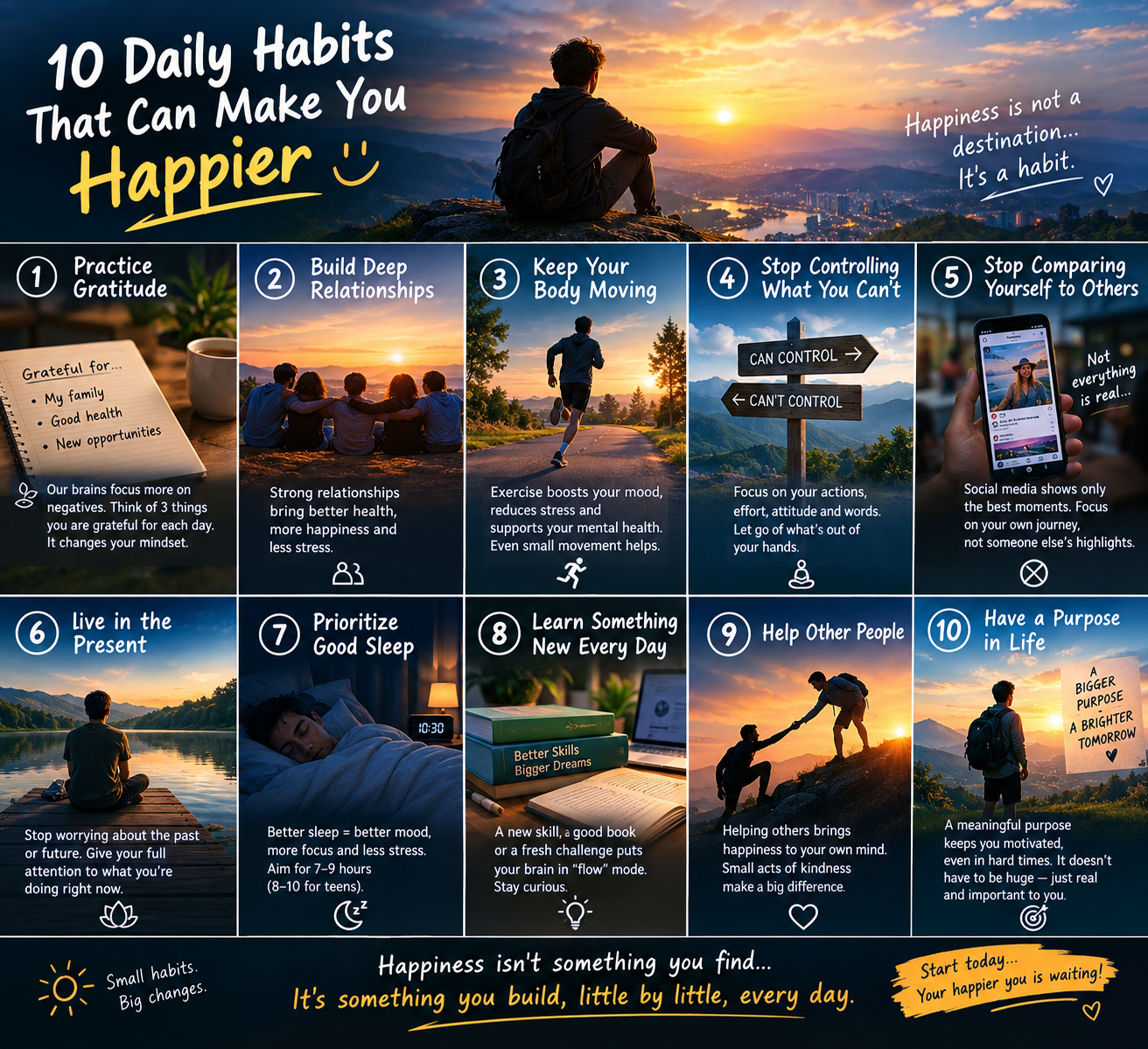
10 Daily Habits That Can Make You HappierWhy do we always look for happiness in the future?We often tell ourselves, “When I have enough money, I’ll be happy. When I get that dream job, I’ll be happy. When I marry the person I love, I’ll finally be happy.”But think about it: whenever you finally received something you had wanted for years, how long did that happiness last? A few days? A few weeks? Eventually, life returned to normal, and the feeling of emptiness sometimes came back.The truth is that happiness is not a destination we reach one day. It is something we can develop through our daily habits, choices, relationships, and the way we train our minds.Here are 10 science-informed habits that can help build a happier and more peaceful life.1. Practice GratitudeOur brains naturally pay more attention to negative experiences. This is often called the negativity bias.One simple way to counter this is to think of three things you are grateful for every day. You can write them down or simply reflect on them before going to sleep.Over time, this can help shift your attention toward the positive parts of your life.2. Build Deep RelationshipsOne of the most important findings from the long-running Harvard Study of Adult Development is that strong relationships are closely associated with better health and well-being.Money and achievements can be valuable, but having people you can trust, talk to, and share life with can make a major difference.3. Keep Your Body MovingExercise is not only about building muscles or changing your appearance. Physical activity can also support mental well-being.Walking, playing a sport, cycling, or simply staying active can improve mood and reduce stress.You do not necessarily need an intense workout. Even regular movement can be beneficial.4. Stop Trying to Control What You Cannot ControlA lot of stress comes from trying to control other people, their opinions, or situations that are outside our influence.Instead, focus your energy on what is within your control: your actions, effort, attitude, and words.Learning to accept what you cannot change can bring a greater sense of peace.5. Stop Comparing Yourself to OthersSocial media often shows only the best moments of people’s lives.We may compare our ordinary days, struggles, and mistakes with someone else’s carefully selected photos and videos.Remember: you are seeing only a small part of another person’s life. Focus on your own progress instead of constantly comparing yourself with others.6. Learn to Live in the PresentMindfulness means paying attention to the present moment.Sometimes we become unhappy because we keep thinking about mistakes from the past. At other times, we become anxious because we constantly worry about the future.Try to give your full attention to what you are doing right now—eating, walking, studying, working, or talking to someone.7. Prioritize Good SleepSleep has a powerful effect on our mood, concentration, and emotional health.When you consistently do not get enough sleep, you may become more irritable, stressed, or emotionally sensitive.For most teenagers, experts generally recommend 8–10 hours of sleep per night, while adults generally need 7–9 hours.Good sleep is not a luxury; it is an important part of taking care of your brain.8. Learn Something New Every DayLearning a new skill, reading a useful book, exploring a new subject, or taking on a meaningful challenge can make life more interesting.When we become deeply engaged in a challenging activity, we may experience what psychologists call flow—a state of intense focus in which we can lose track of time.Keep your curiosity alive.9. Help Other PeopleHelping others can also improve our own sense of well-being.You can help someone with a problem, support a friend, teach someone something you know, or simply make someone smile.Small acts of kindness can create meaningful connections and give life a greater sense of purpose.10. Have a Purpose in LifeHaving a meaningful purpose can help people stay motivated during difficult times.Psychiatrist Viktor Frankl wrote extensively about the importance of meaning and purpose in human life.Your purpose does not have to be something huge. It could be becoming a better person, learning a skill, supporting your family, helping others, creating something meaningful, or contributing to your community.Final ThoughtsHappiness is not something you have to wait for.It is not hidden inside a new phone, a better job, more money, or a perfect future. Those things can certainly bring temporary enjoyment, but lasting well-being is also shaped by how we live every day.Start with just one habit.Practice gratitude. Sleep better. Move your body. Spend time with people you care about. Stop comparing yourself to others. Learn something new. Help someone.Small habits, repeated consistently, can gradually change the way you experience your life.Maybe happiness was never far away. Maybe we were simply looking for it in the wrong place.